
· by Michael Blair, Nashville's Plumbing Repair
The sound is usually a single hard knock, sometimes a short rattle, right after something shuts off: the washing machine changing cycles, the dishwasher filling, a toilet finishing its refill, a single-handle faucet pushed closed. It comes from inside the wall, which is why people call it the pipes banging. The plumbing trade calls it water hammer, and it is one of the few noises in a house that has its own requirement in the plumbing code. Here is what causes it, what it can do, and how we fix it in houses across Nashville, whether the cure is one arrestor at a valve or work on the water lines themselves.
Why do the pipes bang when a valve shuts off?
Pipes bang when a valve shuts off because the water moving through them has to stop all at once, and that sudden stop sends a pressure surge back along the pipe. Oatey’s Quiet Pipes water hammer arrestor brochure reprints the explanation from Canada’s national plumbing code: the longer the pipe and the faster the water, the bigger the surge, and it can reach many times the normal static pressure in the line.
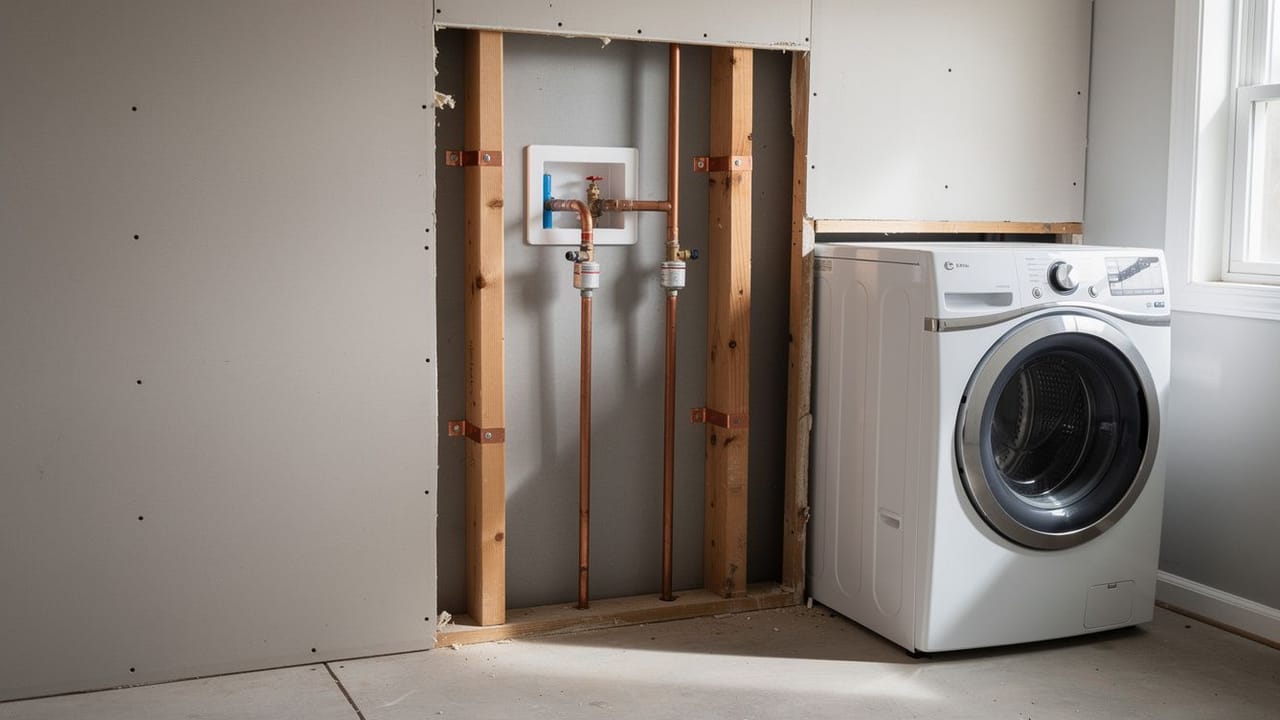
The same brochure names the everyday triggers: flushing a toilet, turning a valve on or off, and a washing machine moving from one cycle to the next. In our experience the knock most often starts after a new washer or dishwasher goes in, because an appliance valve shuts faster than a hand on a faucet usually does. A house that was quiet for years can pick up the noise that way.
Can water hammer damage your plumbing?
Water hammer can damage plumbing, and the manufacturers say so plainly. Oatey’s brochure says that, left alone, it can do harm to the pipe supports, the faucets and valves, and even the water heater, and the Canadian code text it reprints says the surge can be enough to damage the piping system. A knock you have learned to ignore is still a shock going through every fitting between the valve and the main.
The damage is not always where the noise is. A pipe strap can work loose inside a wall, a supply line or a fixture valve can start to weep, and a water heater can take the surge too, which is why our post on why a water heater bangs, pops and rumbles treats a sharp bang after a valve closes as a different problem from the popping of sediment in the tank. When we open a wall to fix water hammer, we check the straps and the fittings along that run as well as the valve that sets it off.
Are water hammer arrestors required by the plumbing code?
Water hammer arrestors are required by the plumbing code at quick-closing valves, according to the code text that Oatey reproduces in its brochure. The International Plumbing Code section it quotes calls for controlling flow velocity to reduce water hammer, and for an arrestor wherever quick-closing valves are used, installed to the maker’s instructions and conforming to the ASSE 1010 standard. Oatey says the Uniform Plumbing Code and Canada’s code require ASSE 1010 arrestors at those valves too. The brochure does not say which edition of the IPC it is quoting.
In Davidson County, the 2024 International Plumbing Code is in force with local amendments, according to the adopted codes list Metro Codes publishes. The Canadian code text in Oatey’s brochure adds two points worth knowing: a vertical stub of pipe used as an air chamber does not give acceptable protection, and arrestors are not needed at every valve or faucet, or in every piping system. Our post on which plumbing jobs need a permit in Nashville covers when work like this has to be permitted.
Where should a water hammer arrestor be installed?
A water hammer arrestor should be installed close to the valve that causes the surge, and on a branch serving several fixtures, near the end of the run. Sioux Chief’s sizing and placement guideline for its Hydrarester arrestors puts one arrester within 6 feet of the last fixture on a branch of 20 feet or less, and treats a longer branch as separate 20-foot sections with an arrester at the end of each. It sizes the arrester by the fixtures it serves and goes up one size when the flow pressure at the fixture is over 65 psig.
Oatey lists its smallest residential size for dishwashers, washing machines and tub and shower valves, and says those arrestors are approved for installation with no access panel. Both documents are manufacturers’ guides, and Sioux Chief’s own advice is to check the local code first. On a call we find which valve sets off the knock, fit the arrestor where the guide puts it, and measure the house pressure, since the guide steps the size up above 65 psig; our post on water pressure that is too high explains that test. If a new washer or a fixture we install is the trigger, the arrestor goes on with it. To have the noise traced, ask us for an estimate.
Sources
- Oatey, Quiet Pipes Water Hammer Arrestors brochure (LCS1076) — Manufacturer’s brochure: common causes; damage to pipe supports, faucets, valves and water heaters; reprints the IPC water-hammer section (edition not stated), UPC 609.10 and the Canadian code note on air chambers; AA arrestors for dishwashers, washers and tub/shower valves, no access panel required
- Sioux Chief, Hydrarester Sizing and Placement Guideline — Manufacturer’s guide: within 6 feet of the last fixture on branches of 20 feet or less; each 20-foot section on longer branches; next size up above 65 psig flow pressure; consult local codes
- Metro Nashville Codes, Adopted Codes List — 2024 International Plumbing Code adopted with local amendments (BL2025-898)
FAQ
Pipes Banging in the Wall: Water Hammer and the Fix — questions
Why do my pipes bang when the washing machine fills?
Washing machine valves are electric and close in an instant, so the water moving to the machine stops all at once and sends a pressure surge back through the pipe. Oatey names washing machine cycle changes as a common cause of water hammer. An arrestor at the washer valves usually stops it.
How do you stop water hammer in house pipes?
Find the valve that sets it off, then fit an ASSE 1010 water hammer arrestor close to it, or near the last fixture on that branch as Sioux Chief’s placement guide describes. Check the house water pressure as well, since high flow pressure calls for a larger arrestor, and tighten any loose pipe straps along the run.
Is water hammer bad for pipes?
Yes. Oatey’s brochure says untreated water hammer can do harm to pipe supports, faucets and valves, and even the water heater, and the Canadian plumbing code text it reprints says the surge can be strong enough to damage the piping system. A knock that repeats every day is worth tracing to the valve causing it.
Does an old air chamber stop water hammer?
Not reliably. The Canadian plumbing code text reprinted in Oatey’s brochure says an air chamber made from a vertical piece of pipe does not give acceptable protection, which is why manufactured arrestors are required instead. Oatey says the US model codes call for ASSE 1010 arrestors at quick-closing valves.