
· by Michael Blair, Nashville's Plumbing Repair
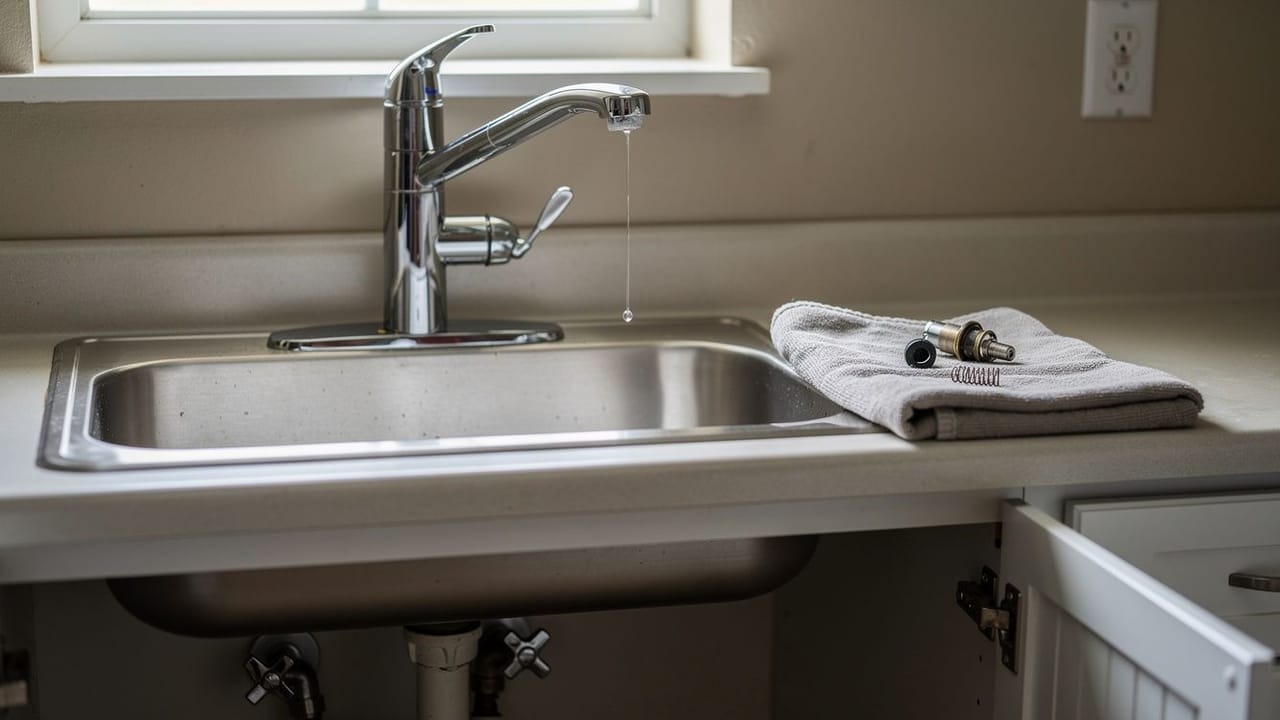
A drip at the spout is easy to live with, which is why so many of them run for months. The EPA’s Fix a Leak Week page puts a faucet dripping once a second at more than 3,000 gallons a year, so the slow tap in the hall bath is not free. The good news is that a drip almost always comes down to one small part. Which part depends on how the faucet is built, and that is what decides whether we repair it or put in a new one on a fixture call.
Why does a faucet keep dripping after it is turned off?
A faucet keeps dripping because the seal that is supposed to block the water when the handle is closed no longer meets its seat squarely. The EPA names old, worn washers and gaskets as a frequent cause. Every time the handle opens and closes, that seal is pressed, twisted or rubbed, and eventually it lets a thin stream past.
Water conditions speed this along. Delta’s own instructions for a single-handle faucet dripping from the spout say normal use and local water conditions wear the seats and springs, and that sediment and debris can collect inside the faucet. Middle Tennessee water comes off limestone and carries minerals with it, so scale on a seat or a grain of grit under a seal is a common starting point for a drip here.
Which part is worn depends on the faucet
Older two-handle faucets with handles that turn several times before they close are compression valves. A rubber washer on the end of the stem presses down on a brass seat. A drip that slows when you crank the handle harder is the classic sign of a worn washer or a pitted seat, and over-tightening it only wears both faster.
Most newer faucets use a cartridge. Moen’s support article on a bathroom faucet dripping from the spout says the cartridge is usually the reason, and that a single-handle faucet has one while a two-handle faucet has two. The cartridge is replaced as a unit.
Single-handle ball faucets work differently again. Delta’s steps go through the handle, cap, cam and ball to two small rubber seats sitting on springs, which are the usual wear parts. The ball itself is checked for damage and mineral deposits; Delta suggests soaking it in vinegar and replacing it if it is damaged.
Is a dripping faucet worth repairing, or should it be replaced?
A dripping faucet is worth repairing when the body is sound and the parts are still made. A cartridge, a pair of seats and springs or a stem washer costs far less than a new faucet and the labor to swap one out. Moen offers a parts warranty alongside its faucet warranty, so it is worth knowing the brand before anyone buys parts.
Some faucets are past repair. Delta says that if the drip continues after new seats and springs, the stainless liners inside the valve body should be checked, and that the whole faucet should be replaced if they are missing, damaged or sticking up above the brass. Delta also tells owners to stop and call a plumber if the cam starts to turn while the cap is being unscrewed. Corroded bodies and discontinued cartridges are the other common reasons we recommend a new faucet over a repair.
What can you check before the plumber arrives?
You can find out which side is dripping and what kind of faucet you have. Close the hot stop valve under the sink and watch the spout for a few minutes, then open it and do the same with the cold. If the drip stops when one side is closed, that side holds the worn part, and on a two-handle faucet that halves the job.
Delta’s first step for a spout drip is simply to clear debris: take off the aerator, run water through the faucet for a minute, clean the aerator and put it back. That alone sometimes ends a drip that started after the water was off. Look for a brand name on the faucet or the box under the sink, and take a photo of the handle style. If the drip is not the only thing wrong and the whole house has gone weak too, our post on low water pressure in the whole house covers where that comes from.
We repair and replace faucets across Nashville and the surrounding counties. To have a drip looked at, ask us for a free estimate.
Sources
- U.S. EPA WaterSense, Fix a Leak Week — A faucet dripping one drip per second can waste more than 3,000 gallons per year; old and worn washers and gaskets frequently cause faucet leaks
- Moen, Bathroom Faucet: Dripping From The Spout — The reason is usually the cartridge; single-handle faucets have one cartridge, two-handle faucets two; Moen faucet and parts warranties
- Delta Faucet, support answer for a single-handle kitchen faucet that drips — Flush debris and clean the aerator; seats and springs wear with use and local water conditions; check the ball for mineral deposits; replace the faucet if the liners are damaged; call a plumber if the cam turns
FAQ
A Dripping Faucet: Washer, Cartridge or Seats — questions
How can you tell whether the hot or the cold side of a faucet is dripping?
Close one of the two stop valves under the sink and watch the spout for a few minutes. If the drip stops, the worn washer, cartridge or seat is on the side you closed. If it keeps going, open that valve and close the other. On a two-handle faucet, only that side needs parts.
Can a leaky faucet be fixed without buying a new faucet?
Usually, yes. Moen says a spout drip is usually the cartridge, and Delta’s single-handle faucets are usually fixed with new seats and springs, sometimes a new ball. Replacement makes sense when the valve body is damaged, the liners are loose or missing, or the parts are no longer made.
What makes a faucet start dripping again after a repair?
The part that was replaced may not have been the worn one. On a Delta ball faucet, the seats and springs are usually the cause, but Delta says to check the ball for damage and the stainless liners in the body if the drip continues. Grit left in the lines after the repair can also hold a new seal open.
How much water can a dripping faucet waste in a year?
More than most people expect. By the EPA’s Fix a Leak Week figures, a faucet leaking a drop every second throws away upward of 3,000 gallons over a year. A slow drip is less than that, but it keeps going day and night until the worn part is replaced.