
· by Michael Blair, Nashville's Plumbing Repair
Almost nobody calls a plumber about high water pressure, because nothing about it looks wrong until a valve or a hose gives way. The pressure in a house is not fixed, either. Metro Water Services’ article on why a shower loses pressure explains that when many customers draw water at once, it moves faster through the pipes, friction builds and pressure drops, with higher elevations feeling it most. The same article notes that pressure trends inversely with flow, so the quiet hours, when the neighborhood is using little, are when your plumbing sees the most of it.
What should water pressure be in a house?
There is no single number stamped on every fixture, but the federal efficiency rules give a sense of scale: 10 CFR 430.32 measures a faucet’s maximum flow at a flowing pressure of 60 psi and a showerhead’s 2.5 gallons per minute at 80 psi. In Metro Nashville the plumbing code is the 2024 International Plumbing Code, adopted with local amendments according to Metro Codes’ adopted codes list, while the State Fire Marshal’s rule on adopted codes lists the 2021 edition. We treat a static reading above 80 psi as the point to talk about a pressure-reducing valve, and we check the current edition and Metro’s amendments before we quote one.
A gauge that threads onto an outside hose bib answers the question. Turn off every tap and appliance in the house first, then take one reading at a quiet hour and another during the morning rush. Metro Water puts the indoor peak at 7 to 9 a.m., with many sprinklers already running from 4 or 5 a.m. in summer, so a morning reading is closer to your lowest pressure and a quiet-hour reading is closer to your highest. The high one is the number that matters here.
What does high water pressure damage first?
When we suspect high pressure, we start with the parts that open and shut against it: the inlet valves on the washing machine and dishwasher, and the supply hoses that feed them, rubber ones in particular. Then the toilets and taps. A fill valve that will not quite shut off, or a faucet that drips again soon after a repair, is a reason to put a gauge on the system before replacing more parts, and our post on a toilet that refills by itself at night walks through the fill valve and flapper checks.
The water heater’s temperature and pressure relief valve is the other one to watch. Bradford White’s installation manual for its power vented gas heaters says a relief valve that discharges periodically may be due to thermal expansion in a closed water supply system, and it tells owners not to plug the valve’s outlet. Capping it would only hide the warning; what needs fixing is how the expansion is handled.
Thermal expansion, and why a PRV needs a tank
Once water in the house cannot flow back toward the main, the house is a closed system. Bradford White’s example is a backflow preventer in the cold water supply. Whether a pressure-reducing valve has the same effect depends on how that valve is built, so we look at the one in the house rather than assume. In a closed system, water that expands as the heater warms it has nowhere to go, and the pressure in the pipes rises instead.
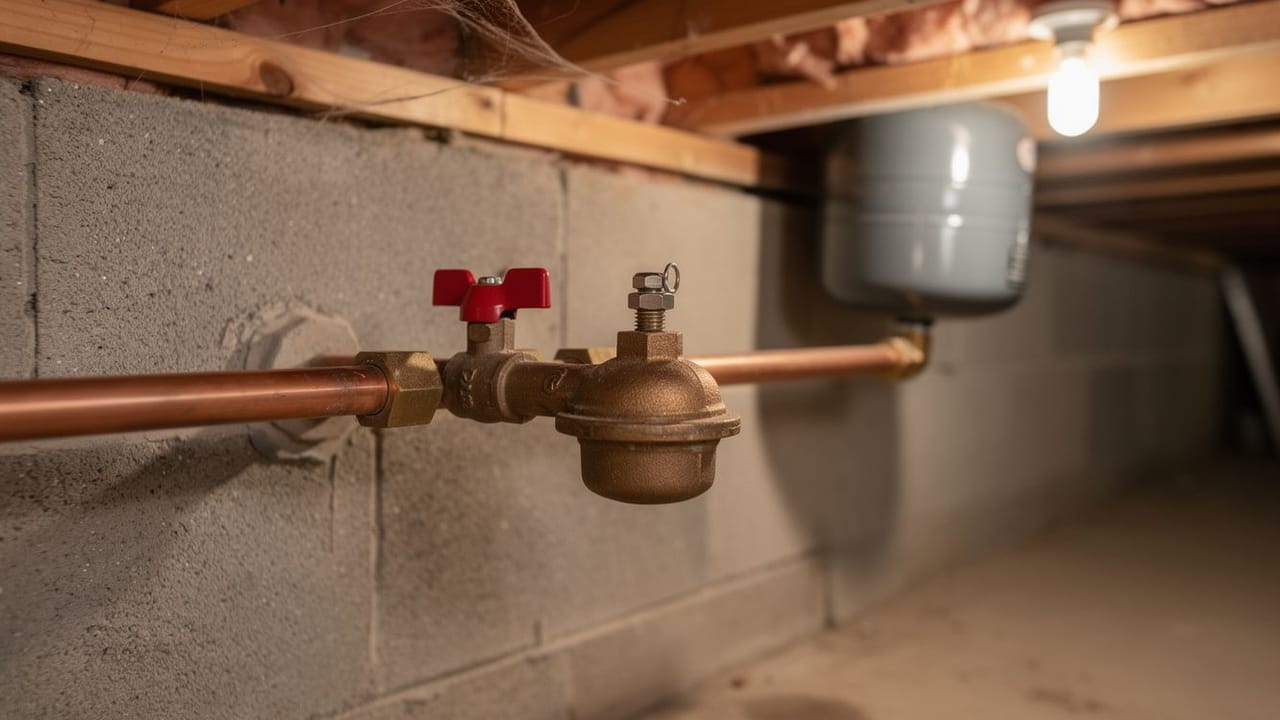
That is what a thermal expansion tank is for. A. O. Smith’s page on its residential expansion tanks says they keep a home’s water pressure from getting high enough through thermal expansion to damage the plumbing, and Bradford White says not to run its heater in a closed system without some provision for controlling expansion, leaving the method to the water supplier or the local plumbing inspector. Fitting a PRV and ignoring expansion moves the problem rather than solving it. If a plumber quotes a PRV and says nothing about thermal expansion, ask why; expansion tanks are part of our water heater work.
Whether yours is working
A pressure-reducing valve is a mechanical part, and we do not have an honest single figure for how long one lasts. The maker’s literature for the model in your house is the place to look for that. What we can tell you is how to see whether it is still doing its job: a gauge reading that sits above the pressure the valve was set to means it is no longer holding the line.
If your house has one, take a reading once a year and write it down. A number that has climbed since the last one is the reason to have the valve looked at, before the appliance valves and supply hoses carry the difference. If yours has crept up, ask us for a free estimate.
Sources
- Metro Water Services, The Surprising Reason Your Shower May Lose Pressure (October 6, 2026) — Pressure drops as demand and friction rise, higher elevations feel it most, pressure trends inversely with flow; indoor peak 7 to 9 a.m., sprinklers from 4 to 5 a.m. in summer
- eCFR, 10 CFR 430.32 Energy and water conservation standards — Faucet flow measured at a flowing pressure of 60 psi; showerheads 2.5 gpm at a flowing pressure of 80 psi
- Metro Nashville Codes, Adopted Codes List (updated July 28, 2025) — 2024 International Plumbing Code adopted with local amendments (BL2025-898)
- Tennessee State Fire Marshal, Rule 0780-02-02 Adopted Codes and Standards (April 2025) — Statewide rule lists the International Plumbing Code, 2021 edition
- Bradford White, Power Vented Gas Water Heater Installation and Operating Instruction Manual (238-45637-00 Rev N) — Closed system example is a backflow preventer; provisions must be made to control thermal expansion; periodic relief valve discharge may be thermal expansion; do not plug the relief valve outlet
- A. O. Smith, Residential Water Heater Expansion Tanks — Expansion tanks keep thermal expansion from raising home water pressure high enough to damage plumbing
FAQ
High Water Pressure Is Quietly Costing You — questions
What is a normal water pressure for a house?
There is no one figure that suits every house, and we would rather read yours than guess. Federal efficiency rules measure faucet flow at 60 psi and showerhead flow at 80 psi, and we treat a static reading above 80 psi as the point to talk about a pressure-reducing valve. A hose-bib gauge, read at a quiet hour with everything in the house off, tells you where you sit.
Can high water pressure cause a leak?
It can contribute. Pressure does not usually make a hole on its own, but a weak joint, a worn washer or an aging supply hose is under more strain at a higher pressure than at a lower one. A house with repeated small leaks in unrelated places is worth a pressure reading before chasing each one.
Do I need a pressure-reducing valve?
If your static reading is above 80 psi, that is where we recommend one, and we check the current plumbing code and Metro’s local amendments before quoting it. If the valve leaves the house as a closed system, it also needs a way to control thermal expansion, such as an expansion tank; Bradford White’s manual says not to run a water heater in a closed system without one.
How do I know if my water pressure valve is bad?
Compare a gauge reading with the pressure the valve was set to. Thread the gauge onto an outside hose bib, turn off every tap and appliance, and read it; a number above the setting means the valve is no longer holding. Take a reading once a year and write it down, so a slow climb shows.