
· by Michael Blair, Nashville's Plumbing Repair
A sulfur or rotten egg smell that appears only when you run hot water comes from a reaction inside the water heater, between the anode rod, the sulfates already in the water and bacteria living in the tank. Rheem’s service bulletin on smelly water calls it a water chemistry condition rather than a water heater problem: the cause comes in with the supply and only shows itself once the water is heated. The first thing to establish is which tap it comes from.
How do you tell whether the smell is the water heater?
Run a cold tap and let it go for a minute. If the cold water smells too, the heater is not the whole story. On city water that is worth reporting, since Bradford White’s technical note on the odor says properly chlorinated public water, as a rule, kills the bacteria. On a private well, the same note says it is usually the pressure tank and the piping that are contaminated.
If only the hot side smells, the tank is where it is happening. Rheem says these bacteria cannot grow in the presence of atmospheric oxygen, which may be why nobody notices them in the cold supply, and that the odor is strongest when water is first turned on or heated. It is usually worse after a stretch away from the house, because water that has stood still and lost its oxygen is exactly where they make the gas.
What is actually happening in the tank
Most tank heaters have a magnesium or aluminum anode rod in them. The steel tank’s first protection is its glass lining, which Rheem’s bulletin on anode rods and the porcelain lining says is actually porcelain enamel, and the anode backs it up by corroding in place of the steel. A few designs have no rod you can get to: Rheem names heat pump models, point-of-use heaters of 20 gallons or less and some direct-vent models.
Sulfate-reducing bacteria, which Rheem calls harmless to health, use the hydrogen from the anode reaction to turn sulfates into hydrogen sulfide gas. Bradford White boils it down to three ingredients: sulfur, hydrogen and bacteria. The more active the anode, the more gas. Rheem puts the threshold low, too, with the odor detectable at about 0.5 parts per million and a true rotten egg smell by 1 to 2 ppm.
The water itself is not the worry it smells like. The CDC’s ToxFAQs on hydrogen sulfide notes that it can form in hot water heaters and says health effects are unlikely at typical environmental concentrations, and the EPA’s guidance on nuisance chemicals treats odor as an aesthetic standard rather than a health risk. Nothing about the smell means the tank is failing.
How do you get rid of the rotten egg smell?
Both makers start with chlorine. Rheem lists chlorination ahead of a new rod and gives a shock of one gallon of bleach for every 30 gallons of tank, left for an hour and then run out through every hot faucet to clean the lines. Bradford White’s version begins with the water and the power or gas shut off, uses half a gallon to a gallon of bleach, and wants it left at least 3 hours, ideally a full day. Neither treats a one-time shock as permanent: Rheem says chlorination is 100% effective only with a continuous chlorine feeder installed.
We do not turn the thermostat up to cook the bacteria out. Bradford White says they tolerate heat up to approximately 225ºF, and hot water does its own damage: the CPSC’s guide to avoiding tap water scalds says a six-second exposure to 140-degree water can cause third-degree burns, and recommends 120°F.
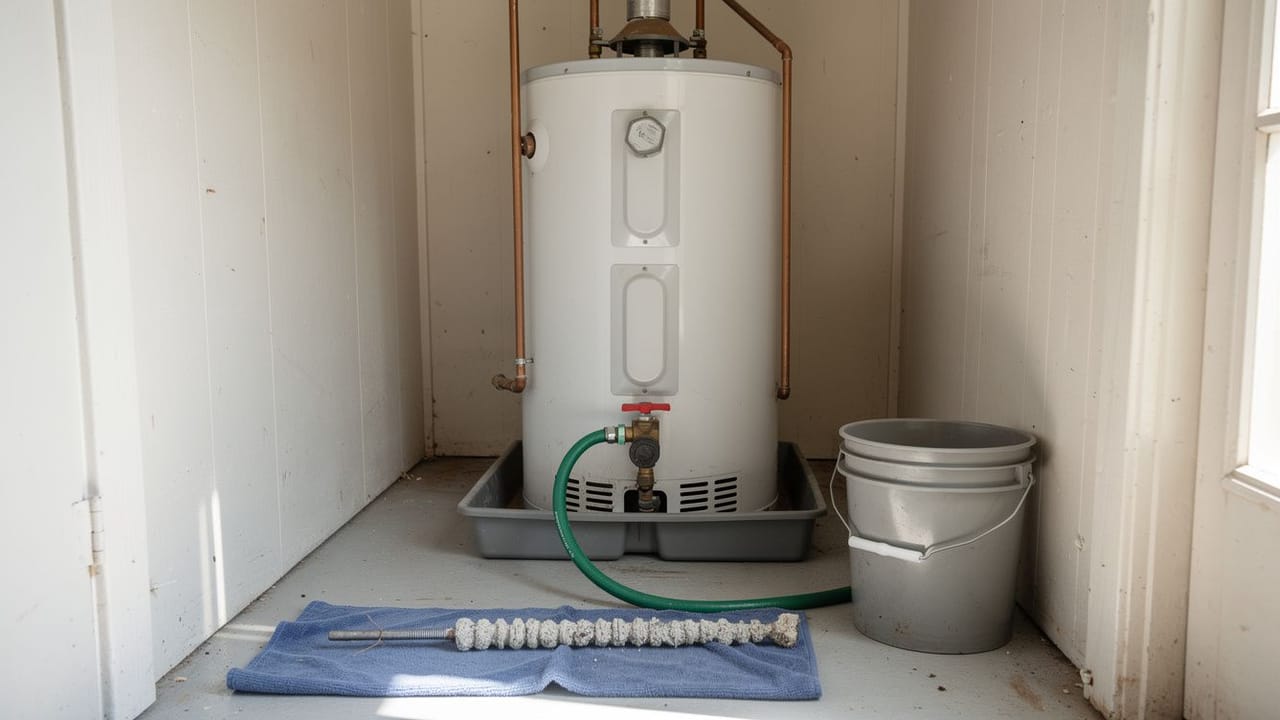
A new rod comes second. Rheem’s lower-activity R-TECH anode, fitted after a bleach flush, reduces the hydrogen available to the bacteria, and Bradford White says replacing the magnesium rod with its A420 anode may minimize the problem. Both are frank that it may not end it, because without continuous chlorination the bacteria can still grow in the tank. We fit the rod the heater’s maker specifies, and our water heater repair service does the flush and the rod on the same visit.
- Confirm the smell is on the hot side only
- Chlorinate the tank with the power or gas off, then flush every hot tap
- Fit the maker’s lower-activity anode in place of the magnesium rod
- Keep the thermostat at 120°F
Should you take the anode rod out?
Do not simply remove the anode rod. It is a common piece of advice online, and it does take the smell away, since Bradford White says a perfect glass-lined tank with no rod would make too little hydrogen to create an odor. The same note says corrosion would then penetrate the steel in time, and that removing the anode entirely will void the warranty and shorten tank life. Rheem says the same of its own heaters: running without the rod greatly shortens the life of a glass-lined tank and excludes warranty coverage.
If the smell has come back after a new rod and a shock, Rheem’s next step is a continuous chlorine feeder, and for a private well Bradford White points to a chlorine injector or UV treatment. On an older tank the money may go further toward a replacement, and our post comparing tankless and tank heaters covers what to put in its place. Either way, tell us which taps smell and how long it has been going on and we will come and look.
Sources
- Rheem, Technical Service Bulletin 1206: Smelly Water and the Rotten Egg Odor — Water chemistry condition, source in the supply; bacteria need no oxygen and react in stagnant water; 0.5 and 1 to 2 ppm odor levels; chlorination first, one gallon of bleach per 30 gallons for an hour; continuous feeder; R-TECH anode may not be 100% effective; worse in softened water
- Rheem, Technical Service Bulletin 1201: Anode Rods, Cathodic Protection and the Porcelain (glass) Lining — Porcelain enamel lining plus anode; models without an accessible rod; bacteria harmless to health; more anode activity, more gas; removing the rod shortens tank life and excludes warranty; softened water raises anode demand
- Bradford White, Hydrogen Sulfide Odor / Rotten Egg Smell and Chlorinating Water Heaters (2020, updated 2024) — Sulfur, hydrogen and bacteria; chlorinated public water kills the bacteria; well pressure tank and piping; heat tolerance to about 225ºF; A420 anode may minimize it; removal voids warranty; chlorination procedure; injector or UV for wells
- U.S. Consumer Product Safety Commission, Avoiding Tap Water Scalds (Publication 5098, 2012) — 120°F recommended; third-degree burns from six seconds at 140 degrees
- CDC/ATSDR, ToxFAQs: Hydrogen Sulfide (reviewed 2017) — Forms in hot water heaters; health effects unlikely at typical environmental concentrations
- U.S. EPA, Secondary Drinking Water Standards: Guidance for Nuisance Chemicals — Odor standards are aesthetic, not a health risk; odor-free water is not necessarily safe
FAQ
Why Your Hot Water Smells Like Rotten Eggs — questions
Is smelly hot water safe to use?
At the levels that cause a household smell, generally yes. The CDC says hydrogen sulfide can form in hot water heaters and that health effects are unlikely at typical environmental concentrations, and Rheem describes the bacteria as harmless to health. The EPA does caution that odor-free water is not necessarily safe to drink, so the smell is no test either way. It is still worth fixing, because it means the bacteria are established in the tank.
Why did the smell start after we were away for a week?
Standing water is what the bacteria need. Rheem says they produce the gas in stagnant water that has been depleted of oxygen, and normal daily use keeps fresh water moving through the tank. A week with no draw gives them the conditions they like, which is why the smell is often strongest on the first shower back.
Will a water softener stop the smell?
No, and it can make it more likely. Rheem says the problem is more prevalent in softened water, where sodium has taken the place of calcium and magnesium, and that softened water drives up the anode’s current demand and shortens its life. The makers’ order of repair is chlorination first, then a replacement rod.
Why does hot water smell like sulfur when cold water doesn’t?
Because the gas is made inside the water heater. Sulfate-reducing bacteria in the tank use hydrogen from the anode rod to turn sulfates into hydrogen sulfide, and Rheem says they cannot grow in the presence of atmospheric oxygen. On city water, Bradford White notes that properly chlorinated supply, as a rule, kills them before they reach the cold lines.