
· by Michael Blair, Nashville's Plumbing Repair
Nobody searches for slab leak repair on a whim. Usually the water bill came in far higher than last month, or a spot on the kitchen tile feels warm under bare feet, or the house is quiet at night except for a faint hiss nobody can trace. Those are real warning signs, but each of them has a cheaper explanation too, and the first job is ruling those out before anyone talks about cutting concrete. This is how our crews work through a suspected slab leak in Middle Tennessee, from the meter test you can do yourself to the choice between opening the floor and abandoning the pipe under it. Our leak detection and slab leak service covers the equipment side; this post is about the decisions.
Start at the meter, not the floor
Every pressurized water line in the house sits downstream of the meter, so the meter is the one instrument that sees all of them at once. The EPA WaterSense Fix a Leak Week page gives the simplest version of the test: write down the meter reading, use no water at all for two hours, and read it again. If the number has moved, something is losing water. The same page puts household leaks in perspective, estimating that an average home’s leaks can waste more than 9,300 gallons a year and that nine percent of homes have leaks losing 50 gallons or more a day.
A moving meter proves there is a leak. It does not prove the leak is under the slab. The most common culprit is still a toilet, because a worn flapper or a fill valve set too high lets water slip into the bowl silently for months; our post on a toilet that refills by itself at night walks through checking for that with food coloring. Close the shutoff behind each toilet and repeat the test. If the meter stops, you have found it, and nobody needs to touch the floor.
If the meter still moves, close the main valve where the line enters the house and watch again. A meter that keeps turning with the house shut off points at the service line between the meter and the house, which runs through the yard, not under the slab. A meter that stops when the main is closed puts the leak inside the house, past the shutoff, and that is when a slab leak becomes the leading suspect.
What the house tells you, and why copper under a slab fails
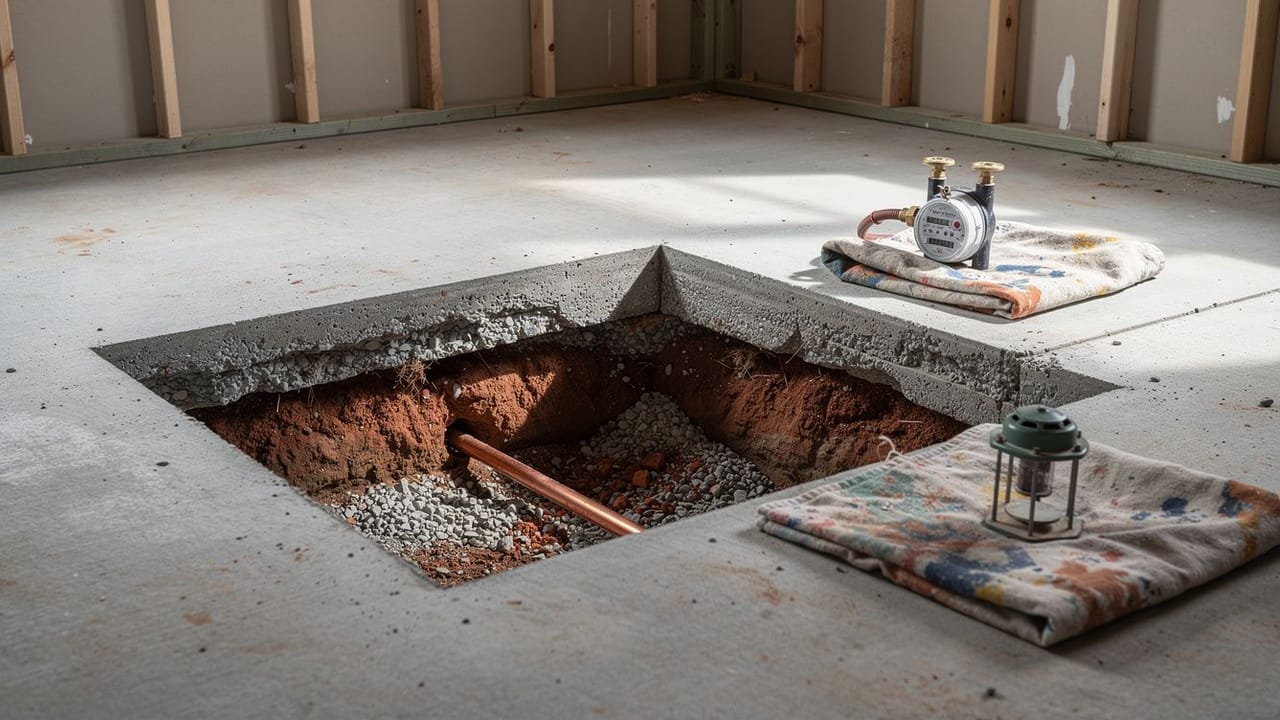
A slab-on-grade house has its supply lines running under or through the concrete to reach the kitchen, the baths and the water heater. When one of those lines fails, the water goes down into the fill and the soil instead of onto a ceiling, so the clues are indirect. A hot water line leaking under the floor warms the concrete above it, which is why a warm patch is one of the stronger signs. A cold line gives no heat, and may only show up as damp carpet tack strip, baseboard that swells at one wall, or a hiss you hear best at night with the house still.
Many older homes around Nashville sit over crawl spaces or basements, where a supply leak drips onto the ground in plain view and nobody needs special equipment to find it. Slab foundations are more common in newer subdivisions and in additions built onto older houses, and on those the clay under the slab matters. Middle Tennessee clay swells when wet and shrinks in a dry summer, and a pipe held rigidly in concrete takes that movement where it enters and leaves the slab.
Supply lines under a slab are often copper, and a common way copper fails is a pinhole rather than a split. The EPA studied this problem in its copper pitting and pinhole leak research, presented in 2004, and found localized pitting to be a significant and widely under-reported problem at many U.S. water utilities, hard to predict and hard to correct. In the one community the researchers examined closely, the leaks were in cold-water lines, most often in the first 20 to 30 feet of horizontal pipe after it entered the home, and the pits were tied to that community’s water chemistry. That study was not about Nashville, and we would not read it as a forecast for any house here.
What it does support is the pattern plumbers watch for: pitting is a condition of the pipe, not a single bad spot. If one pinhole has opened under the floor, the length of copper around it has lived through the same water and the same conditions, and a second leak on the same run is a real possibility. That is the honest reason a slab leak repair is a choice between options rather than a single fix.
Three ways to repair it, and how to choose
Once the leak is located to a spot on the floor, the choice comes down to how much of the old pipe stays in service. None of these is right for every house, and the questions below are the ones worth asking whoever does the work.
Running new supply lines, whether one branch or the whole house, can bring in a permit and an inspection; our post on which plumbing jobs need a permit in Nashville explains when Metro Codes gets involved. For houses inside Davidson County, plumbing in Nashville lists the local offices, and our repiping and water line page covers whole-house replacement.
- Spot repair through the slab: a small opening is cut over the located leak, the damaged section is replaced, and the floor is patched. It disturbs the least, and it leaves the rest of the old line under the concrete.
- Reroute: the failed branch is capped and abandoned under the slab, and a new line runs to the same fixture through the walls or the attic. The floor stays intact, and the new pipe can be reached later without a saw.
- Repipe: every supply line in the house is replaced, usually overhead, when the leak is one of several or the pipe is near the end of its life.
- Ask which line failed, hot or cold, and whether it has failed before.
- Ask what flooring sits over the leak and who restores it, since tile and hardwood change the math on a spot repair.
- Ask for a pressure reading before and after, so you know the rest of the system held.
What Metro Water will and will not do
Two Metro Water Services programs are worth knowing about before and after the repair. On Metro’s list of services provided at no extra charge, plumbing leaks investigation is one of them, arranged by calling 615-862-4600. The page does not say what that visit involves, so treat it as a second opinion on whether there is a leak, not as a locate under your floor.
After the repair, Metro’s assistance and protection programs page says a customer who had a concealed leak may qualify for a bill adjustment under Metro Water Services policy. Once the leak is fixed, you send Metro the type of repair and the date, by email with your account number or by phone. If the bill comes due before an adjustment posts, Metro says to pay it in full to avoid late charges. We have not been able to confirm the policy’s detailed terms, including whether every slab leak qualifies, so keep the invoice that names the repair and the date, and ask Metro directly. When you are ready for us to find the leak, ask for a free estimate.
Sources
- EPA WaterSense, Fix a Leak Week — The two-hour meter test and household leak estimates
- EPA Office of Research and Development, Copper Pitting and Pinhole Leak Research Study — Localized copper pitting and where pinhole leaks appeared in one studied community (2004)
- Metro Water Services, Other Services Provided by Metro Water Services — Plumbing leaks investigation at no extra charge
- Metro Water Services, Assistance and Protection Programs — Concealed leak bill adjustments and how to report a repair